|
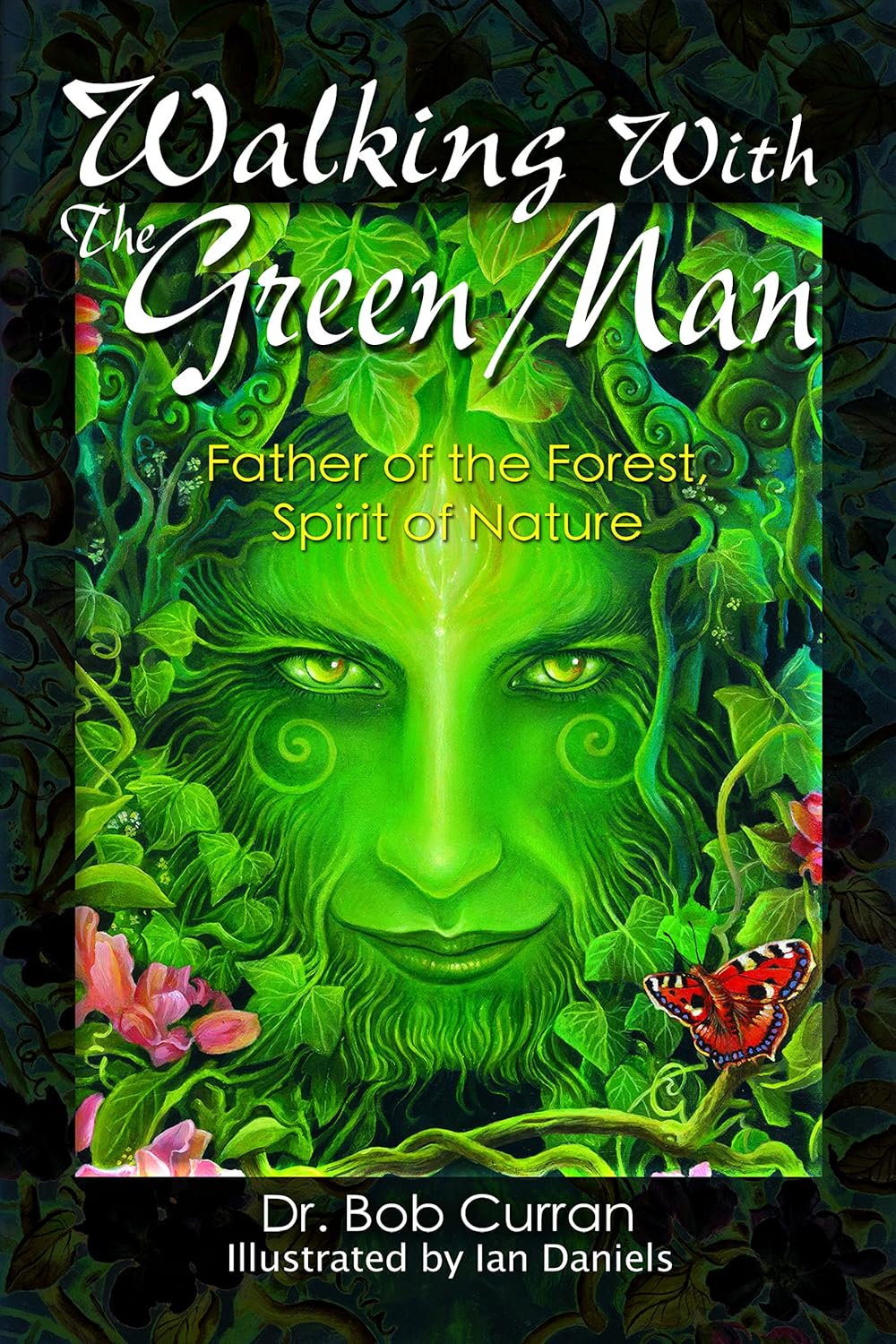
Bob Curran, Walking with the Green Man: Father of the Forest, Spirit of Nature (Career Press, 2007)
Bob Curran's book Walking with the Green Man: Father of the Forest, Spirit of Nature attempts to place the mysterious figure of the ubiquitous carved face -- usually masculine, often jovial in appearance, and always festooned with greenery -- into a historical context, explaining why the image has appeared in so many places, representing so many cultures, straddling the divide between paganism and Christianity. (Green Men have been found in numerous churches throughout Europe, so the image can't have been too abhorrent to early religious leaders.) Curran's efforts here are both laudable and excessive. He certainly does plenty of research, tying the Green Man into its earliest roots and antecedents and exploring its evolution through various European (primarily Celtic, British and Scandinavian) cultures, looking into the reasons the symbol fell out of favor and why it experienced a revival in modern times. On the other hand, he also works a little too hard to tie the Green Man to various gods and spirits from around the world and linking the emblematic figure of the forest to a bevy of huntsmen and herdsmen, death gods and nature spirits. To Curran's eye, the Green Man ubiquitously appears in pretty much every culture, mythology, society and religious tradition you can imagine. As scholarly work, it's a little suspect, since Curran makes plenty of suppositions and draws some tenuous conclusions. He uses words and phrases such as "perhaps," "presumably," "it has been argued" and "it may be assumed" a little too often for my taste. But, as an overall essay on the nature of the Green Man and its possible connections to other figures of folklore, he certainly swings for the fence. Accordingly, you will find his associations between the Green Man and figures as diverse as the Egyptian god Osiris, the Greek god Dionysus, King Arthur and Merlin and the Green Knight, Robin Hood and Little John and King Richard the Lionhearted, the Norse god Odin, Herne the Hunter, the Knights Templar, the Freemasons, Morris dancers, Santa Claus, dryads, satyrs, kobolds, djinn and many more. He even finds (invents?) links to Johnny Appleseed, the Jolly Green Giant, Marvel Comics' Incredible Hulk and DC's Swamp Thing. At times, it seems as if any figure from history, mythology or pop culture that is either 1) green, or 2) depicted as a face or head rather than a whole body must have a Green Man connection. Curran doesn't seem inclined to discuss the possibility that, at a time when societies lived and died by the seasons, more than one culture might have developed a spirit or deity devoted to the cycle of nature and rebirth. That aside, it's actually a very interesting text solely for the comparisons that exist between natural lore and the figures that arose to venerate the green spirit of the world. 

|
 Rambles.NET book review by Tom Knapp 16 August 2025 Agree? Disagree? Send us your opinions!  


 |