|
Gorath, directed by Ishiro Honda (Toho/MGM, 1962)
So what exactly is Gorath, you ask? Well, we'll call it a star because that is how it is referred to in the film (even though, at only 6,000 times the mass of Earth, I believe it falls just a little short of the minimum mass needed for nuclear fusion to occur at its core, and -- with thermonuclear explosions evident all over its surface, it's clearly not a collapsed star). Whatever it is, it's huge and destructive -- and it's on a collision course with Earth! Even as Pluto is torn from its orbit, Earth's tides begin showing the deleterious effects of Gorath's gravitational pull, but scientists don't really begin to panic until the pride of Japan's space-going fleet is destroyed during its Gorath fact-finding mission to the outer solar system. Even as the peoples of the Earth unite in the face of utter annihilation, it looks like the gig is finally up for mankind. To survive, they either have to change the trajectory of Gorath or somehow move the Earth out of its way. Clearly, they can't destroy the object, nor can they alter its course. That leaves the seemingly impossible option of changing Earth's orbit, so this is what they set out to do. This is what makes Gorath such a unique and memorable film. Not only do scientists have to figure out a way to move the Earth into a different orbit, one that will move it a safe distance away from Gorath's massive gravitational pull, but they have to get the job done in a matter of a few months. All of the planet's resources are quickly concentrated on installing a huge number of rocket boosters at the South Pole. Can this mother of all harebrained schemes possibly work? Even as the approaching Gorath wreaks havoc on the planet's land and oceans, a hunkered-down mankind watches with bated breath to see if Rocketship Earth can possibly survive. Even the slightest miscalculation might mean certain doom -- and that's if the plan even works in the first place. At one crucial point, you'll see an airplane fire lasers into the ground for no apparent reason whatsoever. The answer to this little mystery lies in the American editing of the original film, which eliminates six minutes from the Japanese original. Producer Tomoyuki Tanaka apparently insisted, late in the game, that there simply had to be at least one giant monster in the film. Enter Maguma, a reportedly silly-looking walrus-like creature freed from the polar ice by the heat of all of the rockets. I daresay the film is probably better off without the needless inclusion of such a monster, but it's also a pity that American audiences have never been able to see the deleted Maguma sequence. It's even more of a shame that we have thus far been denied a DVD release of Gorath, as the film is in dire need of restoration. Let us be hopeful that such a DVD release does take place someday, with the Maguma sequence included, at the very least, as a special feature. Compared to turning Earth into a rocketship and altering its orbit in order to avoid a rogue star, the act of releasing Gorath on DVD seems like the simplest of requests. 
|
 Rambles.NET review by Daniel Jolley 4 April 2026 Agree? Disagree? Send us your opinions! 


 |
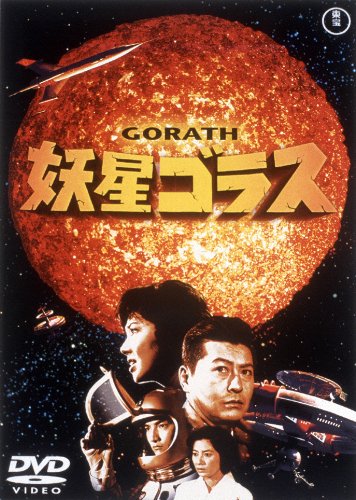 Gorath ain't your regular Toho disaster film. You will find no giant monsters (not in the butchered American edit of the movie, anyway) here in this 1962 classic; you won't even find any warnings about the dangers of nuclear weapons.
