|
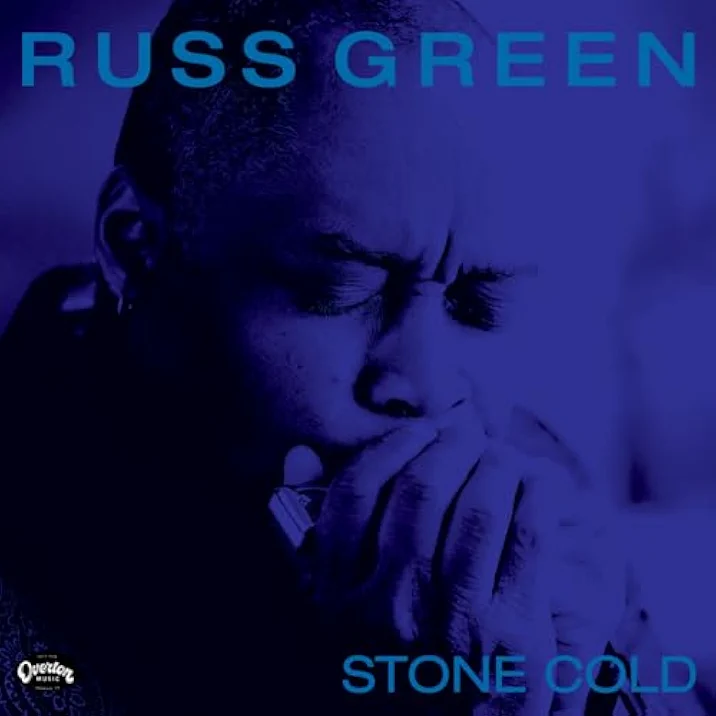
Russ Green, Stone Cold (Overton, 2026)
The young Green, in fact, was not even originally a musician. After high school he moved downstate to attend Southern Illinois University, where he studied film. He took up a casually acquired harmonica for the purpose of entertaining himself with Hendrix numbers on a different instrument. Eventually, back home in Chicago, he happened to visit a North Side blues club where he fell first under the spell of the celebrated harp figure Sugar Blue (James Whiting) and elsewhere, in due course, the equally revered Billy Branch. After a three-year stint in the Army, he worked professionally in Chicago television and film and expanded his blues education in clubs and other venues. In time he issued an acclaimed, award-winning album, City Soul (2018). When I resided in the Windy City over a decade and a half 'til 1989, I monitored its blues scene almost obsessively. Over the ensuing decades, like so much else, that circumstance has been largely lost to memory, sadly. That's why I had not heard -- or even heard of -- Russ Green until late last month, when Stone Cold appeared as a review disc in my mail. I took to it immediately. Here was a guy whose focus seemed entirely on blues, and not in an irritatingly hyphenated variety (an unsubtle allusion to the scourge of blues-rock). My impression -- justified under the circumstances, I think -- was that he had grown up in the tradition, mastered it at a young age, and incorporated more contemporary albeit organic elements (such as soul) into it as he carved his craft. It turns out that, as the opening paragraphs above attest, the reality is more complicated and less cliched. In our time blues no longer defines Black life. Because it is no longer the mother's milk of a particular culture, a number of observers predicted that it would not survive much into this century. Yet it's held on owing to artists whom it has intrigued because it has historical resonance to some in the community that carried it forward and because it's also such a uniquely gripping genre. It is difficult to master, though those moved to do so have carried the tradition stubbornly forward. Some modern-day Black artists have even found their way to early downhome blues, to the style it possessed when it was a rural Southern folk music. Green doesn't do that, but his is a recognizable electrified iteration, yet no pallid rehash, of Chicago's iteration. Without forcing anything, he grasps its soul -- less hyperbolically, its melodic and rhetorical core -- and absorbs it while at moments enticing the ghosts of Hendrix and even Dylan to stroll the stage in cameos. He is also an assured writer of conventional relationship narratives and borderline surrealist lyrics. It all works, and it all comes as a happy surprise. An exceptional five-piece band, with standard instruments, anchors its sound in the bars and joints that inspired Chicago's variant of big-city blues. If you love that approach, what you encounter here will be a friend of long standing, if it's been with you long enough. And if it hasn't been in your life before now, Stone Cold is a place to make its acquaintance. 
|
 Rambles.NET music review by Jerome Clark 23 May 2026 Agree? Disagree? Send us your opinions!  


 |