|
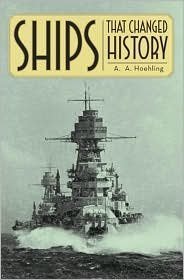
A.A. Hoehling, Ships That Changed History (Madison Books, 1992) Ships That Changed History is a compact volume that takes a close look at -- you guessed it -- several ships that changed maritime history over the last 200 years. Now, nautical aficionados might quibble over some of the choices author A.A. Hoehling has made, but -- while there are certainly plenty of other vessels that would qualify for a chapter in this book -- he has certainly made some valid selections. The book begins with a chapter on 19th-century clipper ships. Not a specific ship, but a class of fast trading vessels that altered the course of global commerce and migration ... although Hoehling does call out several notable ships by name, such as Sea Witch, Flying Cloud, National Eagle, Challenge and, of course, Cutty Sark. He discusses the ship's origins and development, the differences between clippers and other types of ships at the time, their captains and crews, and some key voyages -- including several disasters. Hoehling discusses at length the wooden ships the clippers replaced, the fledgling iron steamships they competed with, and the later steamships that eventually surpassed them.
The third chapter deals with the Monitor, the Union's doughty little cheesebox that raised the stakes on naval warfare during the American Civil War. She didn't look like much and failed to impress pretty much anyone who saw her, but when she sailed into her first battle against the iron-plated Confederate ship CSS Virginia (nee Merrimack she transcended all expectations and opened a new era in military shipbuilding. Hoehling provides a detailed description of her design, her first battle and subsequent uses in the war, and her ill-fated last voyage, then goes on to describe the succession of Monitor-class ships that followed, as well as the evolution of iron battleships that followed in her wake right on through World War II. Next up is RMS Lusitania, a massive luxury liner whose sinking by the Germans precipitated the United States' entry into World War I. Besides a thorough description of the ship itself, and its history, Hoehling writes about the general state of shipping when German U-boats were sinking so many vessels without warning. Lusitania's commander, Captain Bill Turner, discounted any worries, certain that his ship could outrun any foe. Even so, Turner made several errors in judgment that, if he'd planned his route better, might have saved his ship, crew and passengers. Hoehling also provides details about the cruise by U-20, the submarine captained by Kapitanleutnant Walther Schweiger, who racked up quite a headcount before setting his sights on Lusitania. The vessels met unexpectedly off the Old Head of Kinsale, Ireland, on May 7, 1915, and a single torpedo was all it took. All told, 1,197 of roughly 1,960 passengers and crew were killed, including 124 Americans, and the act set off a chain of events that led to the U.S. entering the war less than two years later (a lengthy delay that frustrated a great many people at the time). Chapter five deals not with one ship, but a hodgepodge fleet of them -- the many ships that sailed to Dunkirk over the course of several days in 1940 for the Dunkirk evacuation, codenamed Operation Dynamo, which rescued nearly 339,000 Allied soldiers from the coast of northern France as a larger German army advanced. With such overwhelming numbers needing rescue across the English Channel, the Royal Navy sent the anti-aircraft cruiser HMS Calcutta along with 39 destroyers and other, smaller ships. The Merchant Navy pitched in with passenger ferries, hospital ships, and other vessels. And numerous small boats -- speedboats, ferries, pleasure craft, fishing boats and Thames vessels -- were pressed or volunteered into service for the desperate operation ... often crossing the channel with civilian crews. Many military and civilian ships were lost in the evacuation due to German attacks by air and sea but, because of their efforts, many more soldiers were saved. The book ends with a chapter on the USS Arizona, commissioned in 1916, modernized in the 1930s and assigned as flagship of the fleet at Pearl Harbor in 1940. In this chapter, Hoehling discusses some of the ship's history but focuses more on the warnings that presaged the Japanese attack that were largely dismissed or ignored by everyone with enough military authority to do something about it. Much of the description that follows is culled from reports from the survivors. Himself a U.S. Navy veteran who served during World War II, Hoehling went on to become a journalist and military historian. He wrote more than 30 books of historical nonfiction, many of which focused on the Civil War, World War I and World War II. Ships That Changed History was his 27th book. This book doesn't pretend to be a definitive work on the subject. It looks at just six ships (or groupings of ships) over the past two centuries that had a large impact on the world. Is it comprehensive? No, nor does it claim to be. Readers might argue for the inclusion of RMS Titanic, HMS Dreadnought, the Bismarck, USS Maine, the aircraft carrier Enterprise or any number of other ships on the list, but this is Hoehling's book, so Hoehling chose the ones he wanted to feature. The stories he decided to tell, he tells well, and Ships That Changed History is an interesting addition to any library of nautical history. 
|
 Rambles.NET book review by Tom Knapp 16 May 2026 Agree? Disagree? Send us your opinions!  


 |