|
Bridges of the Susquehanna A rambling by Tom Knapp Those of us who live in York or Lancaster counties in south-central Pennsylvania take the bridges over the Susquehanna River pretty much for granted. The convenient connections across the mighty river carries motorists over one of two bridges -- the four-lane Route 30 bypass bridge, or the older two-lane Route 462 bridge linking the towns of Columbia to the east and Wrightsville to the west. Alongside the Route 462 bridge are the stone piers on which stood an even older, and more historically significant, bridge, which is celebrated on some years with a fiery display. I'll explain why in a minute. Attending an event there on June 28 -- marking the original fire exactly 163 years prior -- inspired me to look up an article I researched and wrote for a local newspaper back in 2010 about the various overpasses on that section of the river. Let's examine the history. The 5,183-foot-long bridge that carries Route 462 over the Susquehanna River -- originally called the Lancaster-York Intercounty Bridge -- is less than a century old, opening more than 90 years ago after a year's construction. It was, when built, the fifth bridge to connect Columbia and Wrightsville along that short stretch of river. (Otherwise, a motorist would need to drive over 30 miles north to cross at Harrisburg, or about 25 miles south to the Norman Wood Bridge, just south of the Holtwood dam in the lower Susquehanna. There are also a handful of crossings in northern Maryland, just north of the Susquehanna's entry point into the Chesapeake Bay at Havre de Grace.) Now called Veterans Memorial Bridge, the Columbia-Wrightsville span was built of reinforced concrete, standing on 27 river piers and 22 piers on the approach, for $2.5 million. Automobiles crossing the 425-million-pound bridge paid a 25-cent toll until Jan. 31, 1943. But the crossing itself is far older. 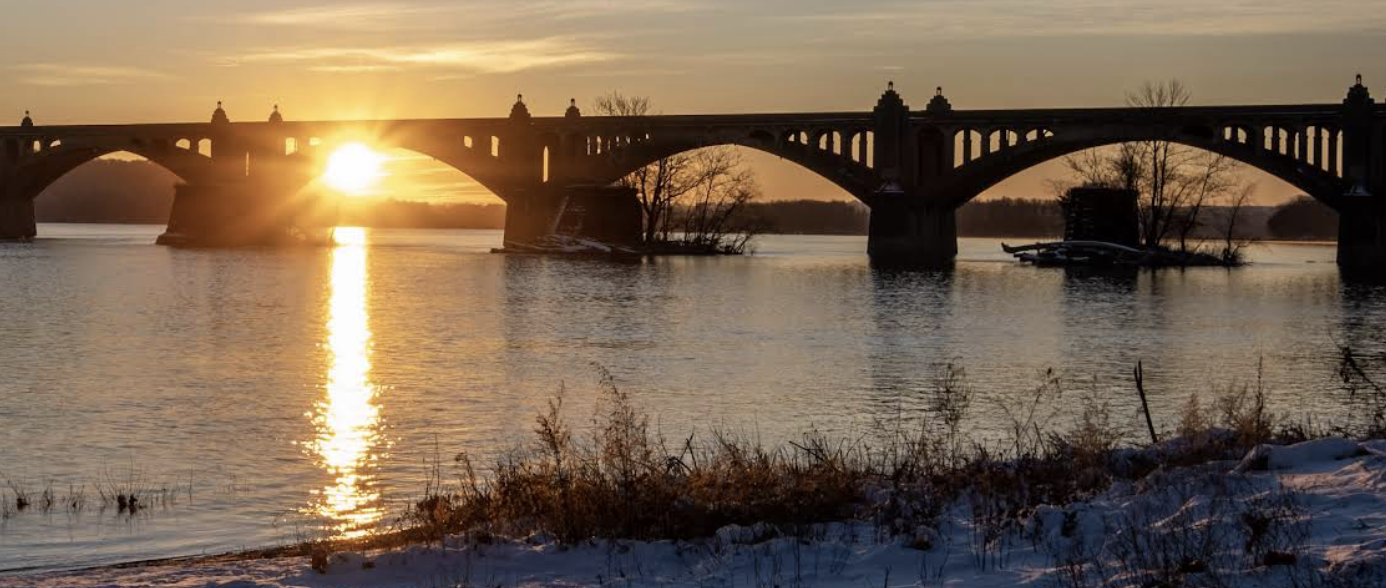
Veterans Memorial Bridge at sunset, with the stone piers Claire Storm, former president of Rivertownes PA USA (a nonprofit group dedicated to promoting and preserving the heritage and economy of towns along the lower Susquehanna River such as Columbia, Marietta and Wrightsville), told me in 2010 that Columbia probably wouldn't exist if it hadn't been such a good spot to cross the river. "I believe the river was and is the lifeline for Columbia," she said at the time. "Columbia and the bridges here certainly opened up the West. A great number of people who were traveling west crossed here in Columbia." Columbia was founded on the back of Wright's Ferry, which started carrying people, horses and wagons across the Susquehanna in 1730. But it wasn't until 1814 that people could walk or ride from bank to bank without a boat. The first bridge -- which stretched 5,690 feet just south of the current Route 30 bridge -- was built of wood and stone, resting on 54 piers. Construction cost $231,771 -- about $2.4 million today -- underwritten by the newly formed Columbia Bank & Bridge Co. A covered bridge, it included a wood roof over twin carriageways and a whitewashed interior. It was believed to be the longest covered bridge in the world at the time, according to various online sources. A wagon with a team of six horses paid a $1.50 toll to cross, while a pedestrian could stride across for 6 cents. Unfortunately, it succumbed to an early thaw, destroyed on Feb. 5, 1832, by a combination of ice and high water. Construction of a second bridge, costing $157,300, began later that year. It opened July 8, 1834, just north of the current Route 462 bridge. Its empty piers are still visible above the water. The wood-and-stone structure -- built in part from materials salvaged from the first bridge -- was 5,620 feet long and stood on 27 piers. It had a carriageway and walkway, plus two bi-level towpaths added in 1840 to guide canal traffic between the Pennsylvania Canal in Columbia and the Tidewater Canal in Wrightsville. A double-track rail line was added sometime after 1846, linking the Philadelphia and Columbia Railroad to the Northern Central Railway. Rail cars were towed across the bridge by horse or mule teams to prevent locomotives from sparking a fire. Like its predecessor, it was considered the world's longest covered bridge at the time. As local Civil War enthusiasts know, this bridge was burned by Columbia volunteers on June 28, 1863, to prevent Confederate troops from crossing the river. With their advance toward Lancaster and Philadelphia halted, the Confederate army turned instead to Gettysburg. And we all know what happened there. (For more information on the burning bridge and the role it played in the Civil War, read Beyond the Burning Bridge: Wrightsville, Pa., in the Civil War by Scott Mingus, reviewed here.) The Columbia Bank & Bridge Co. sold rights to the bridge's remains -- including the valuable piers -- in 1864 to the Pennsylvania Railroad, which built a new bridge on the previous bridge's foundations in 1868 for $400,000. Also a covered bridge, it was 5,390 feet long, made of steel, wood and stone ... and it was destroyed by a hurricane on Sept. 30, 1896. But those old piers weren't left empty for long. The railroad company built a fourth bridge in record time -- construction began on April 16, 1897, and ended May 11 of that year -- using iron and prefabricated steel trusses. However, that bridge was never finished. Although it served trains, cars and pedestrians on a rail line and twin carriageway, plans for an upper deck never came to pass. Known colloquially as the Iron Bridge, it carried passenger trains until 1954 and freight trains until 1958. It was dismantled for scrap in 1963-64, leaving only those old stone piers behind. Construction on Veterans Memorial Bridge began in 1929 and it opened on Sept. 30, 1930. Commonly known as the Columbia-Wrightsville Bridge, it was renamed and dedicated as Veterans Memorial Bridge in 1980. Although no longer covered, it is still considered the world's longest concrete multiple-arch bridge. The most recent addition to that segment of river is the Wrights Ferry Bridge, a modern span that bears four lanes of Route 30 just a half-mile north of Veterans Memorial Bridge. The sixth bridge to cross the river at Columbia, it opened in 1972 after more than three years' construction costing $12 million. The bridge, of reinforced concrete and steel, rests on 45 piers. That's a short summary of a lot of history about a short stretch of river that has been part of my life since I was born. There is no way to count how often I have crossed the Susquehanna in my life, but it's a large number -- and most of those crossings were on the two bridges between Columbia and Wrightsville. (Let's be honest, it's usually Route 30, because it's faster.) 
|
 Rambles.NET rambling by Tom Knapp 18 July 2026 Agree? Disagree? Send us your opinions! 



 |
